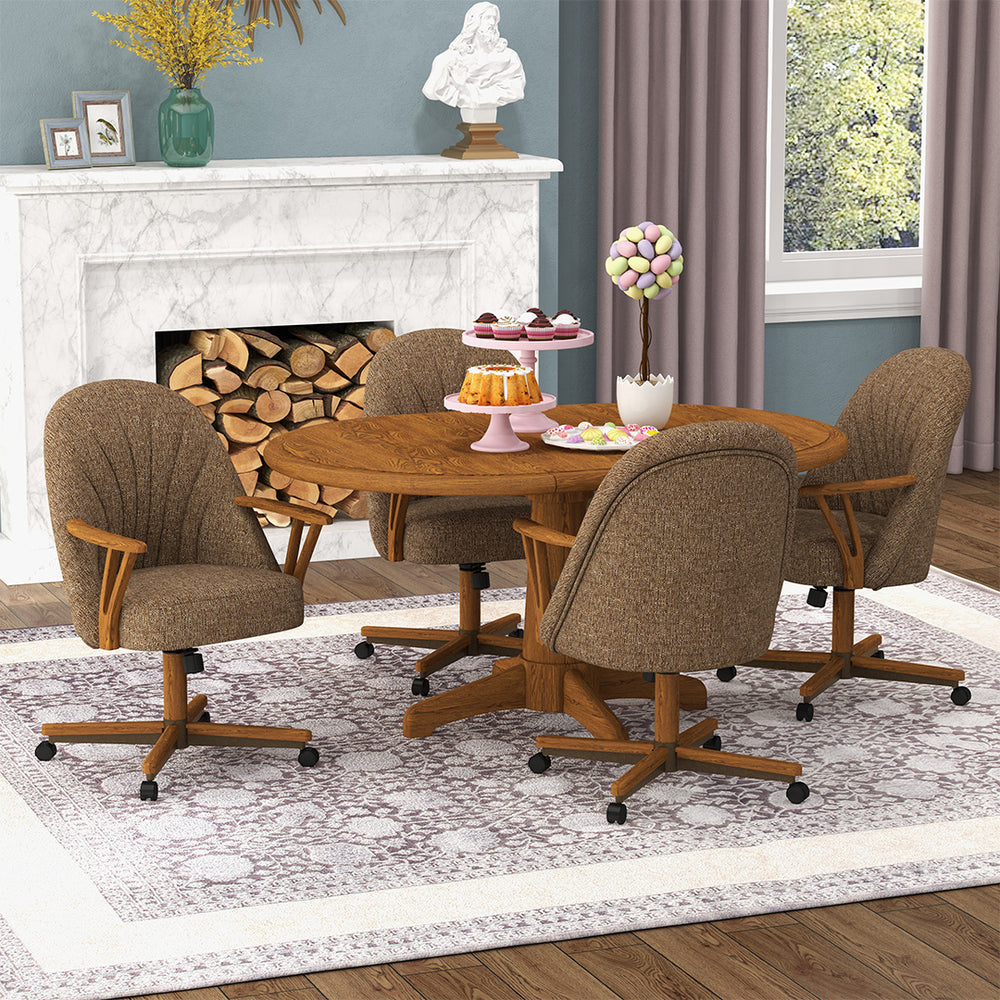




What Should Older Adults Look for in a Swivel Dining Chair with Casters?

A fit-first guide to measurements, movement features, cushioning, and model comparison.
Choosing the right dining chair becomes easier when you know what to look for. For older adults, the best place to start is personal fit: how the chair feels, how it works with the dining table, and how easily it moves within the room.
Seat height and depth, usable width, arm support, table clearance, swivel, controlled tilt, casters, cushioning, and construction all play a role. This guide explains each feature step by step so you can choose a chair that fits you, your table, and your home.
This buying guide helps older adults and adult children compare the details that matter before buying a caster swivel tilt dining chair.

Father and daughter testing the Cameron Collection dining chairs
Quick Answer: Measure the Person, Table, and Room
The right dining chair should fit three things: you, your table, and your room.
Start with you. Check the seat height, seat depth, usable width, back support, arm support, and overall comfort.
Then check your table. Make sure the armrests have enough clearance below the table apron and that the chair can be positioned comfortably at the table.
Finally, check your room and flooring. Make sure there is enough space for the chair to swivel and move, and that the casters are appropriate for the flooring in your dining area.
Whenever possible, sit in the chair before making the final choice. Measurements can narrow your choices, but personal comfort is best experienced in the chair itself.

Buyer’s Comparison Checklist
This checklist gives shoppers a practical way to compare chairs before visiting a dealer or placing an order. Recording each detail by model helps older adults and their families evaluate personal fit, table compatibility, movement features, and floor requirements together.
|
Checkpoint |
What to record or compare |
Why it matters |
|
Seat height |
Floor to the top of the seat cushion |
Shows how the user will relate to the tabletop |
|
Seat depth |
Front edge of cushion to the backrest |
Helps the user make comfortable backrest contact |
|
Usable width |
Space between the armrests |
Shows the actual seating area |
|
Arm height |
Floor to the highest point of each armrest |
Helps determine table-apron clearance |
|
Table clearance |
Height from floor to the lowest apron edge |
Confirms how close the chair can sit to the table |
|
Swivel space |
Room needed for the arms and back to rotate |
Helps the user turn without contacting nearby objects |
|
Tilt tension |
Presence and location of the adjustment knob |
Allows model-specific tilt resistance to be reviewed |
|
Floor and casters |
Hardwood, tile, laminate, carpet, or area rug |
Helps shoppers compare the chair with the home surface |
|
Construction |
Frame, base, cushion, upholstery, and warranty details |
Makes model-to-model comparison more complete |

#1 Start With Seat Height and Seat Depth
Seat height determines the user’s position in relation to the tabletop. The intended user should place the feet comfortably on the floor while sitting at a useful height for dining. The chair should also leave enough room for the lower legs beneath the table.
Shoppers should measure from the floor to the top of the seat cushion. Since these chairs are not designed with adjustable seat height, the product page or dealer should confirm the exact measurement for the selected model.
Seat depth deserves equal attention. A deep seat may place the backrest farther away from a shorter user, while a shallow seat may provide less seating area for a taller user. The goal is a natural relationship between the cushion, backrest, and user.
#2 Check Usable Seat Width, Arms, and Table Clearance
Outside width tells shoppers how much room the chair occupies. Usable width tells them how much seating space exists between the arms. Both measurements belong on the comparison sheet.
Arm height is especially important for a dining chair with arms. Shoppers should measure from the floor to the highest point of the armrest, then compare that number with the distance from the floor to the lowest edge of the table apron. As a practical guideline, allow at least approximately 2 inches of vertical clearance between the top of the armrest and the table apron.
Why does this matter? The tabletop may appear high enough, but the apron can sit lower and prevent the arms from moving beneath it. Table legs and pedestal bases can also affect the final position.
The room deserves a measurement, too. Where space permits, approximately 36 inches from the table edge to nearby walls or furniture provides a useful planning guideline. For more detail, readers can review How Much Space Do Swivel Tilt Dining Chairs Need?
Before ordering, measure both the chair’s arm height and the lowest edge of your table apron to make sure they work together.
#3 Treat Swivel as a Table-Fit Feature
Swivel should be evaluated as part of the chair’s relationship with the table. The seat rotates while the base stays in place, allowing the user to change direction within the chair’s designed range.
The arms and backrest need swivel clearance. A chair may fit beside the table but still need more room to rotate without touching a wall, cabinet, neighboring chair, or floor covering.
Readers can compare this feature with stationary seating in Swivel vs. Fixed Dining Chairs: Which Is Better?
#4 Understand Controlled Tilt and Tension Adjustment
Controlled tilt allows the chair to move gently backward as you lean, providing a comfortable change in sitting position. Unlike a recliner, the movement is limited and controlled, making it appropriate for dining.
Chromcraft swivel-tilt dining chairs include a tension-adjustment knob beneath the seat. The knob allows you to adjust the tilt resistance to a comfortable level based on your preference.
When trying the chair, lean back gently and adjust the tension until the movement feels comfortable for you.
#5 Match the Casters to the Dining Room Floor
Caster performance depends on the wheel design, floor material, surface finish, carpet pile, rug thickness, rug edge, and transitions between surfaces. A caster swivel tilt dining chair should be compared with the actual dining-room floor instead of a smooth showroom surface.
Hardwood, laminate, tile, and finished stone can each create a different rolling experience. A thin, firmly secured, low-pile rug may provide a more consistent surface than a thick or loose rug.
Remote shoppers can ask for caster specifications, flooring guidance, and a demonstration video. In-person shoppers can bring a dining-room photo or request a floor sample from the dealer.
#6 Look Beyond Cushion Thickness
A thick or soft-looking cushion does not automatically mean a more comfortable chair. Seat shape, depth, width, back support, upholstery, arm position, and the construction beneath the cushion all contribute to how the chair feels over time.
Selected Chromcraft models incorporate a patented multi-layer seat support system as part of Chromcraft Comfort Engineering. Multiple layers with complementary support characteristics work together to balance welcoming surface comfort, deeper underlying support, and resilience during extended sitting.
When trying a chair, sit in it for several minutes and consider how the seat, backrest, and arms feel together—not simply how soft the cushion feels at first.
#7 Compare the Details That Matter
Once you find a chair that feels comfortable, compare the practical details of the models you are considering. Focus on the specifications that affect fit, movement, everyday use, and long-term ownership.
Shoppers should request the following information for the exact model:
-
Seat height, depth, usable width, and outside width
-
Armrest height and distance between the arms
-
Swivel range and required clearance
-
Tilt function and tension-adjustment instructions
-
Caster type and floor compatibility
-
Upholstery material and care instructions
-
Warranty coverage and available replacement-part guidance
Features and dimensions can vary by model, so compare the exact chair you are considering rather than relying only on the collection name. An authorized Chromcraft dealer can also help confirm specifications and identify models available to try in person.

Size dimensions of the Chromcraft Medina Collection CM188-C945 Swivel Tilt Caster Casual Dining Chair
#8 Use a Personal Fit Test Before Buying
An in-person test can answer questions that a product page cannot. The intended user should test the chair at a table with similar height, apron dimensions, and floor conditions whenever possible.
The following process gives shoppers a consistent comparison:
-
Sit fully back and check the relationship between the seat depth and the backrest.
-
Place the feet comfortably on the floor and observe the table height.
-
Rest the arms on the armrests and compare them with the table apron.
-
Rotate the seat and check the swivel clearance around the chair.
-
Lean back gently to experience the controlled tilt.
-
Adjust the tension knob and find a tilt resistance that feels comfortable.
-
Reposition the chair across a surface similar to the home dining floor.
If the chair feels comfortable, fits your body, works with your table, and moves well in your dining space, you have covered the most important factors in choosing the right chair.
Recording the answers by model number makes it easier to compare several chairs without blending one model’s features with another’s.

Senior couple testing the Chromcraft Nova Collection dining chairs
Why Chromcraft Specializes in This Category
With roots dating back to 1908, Chromcraft has a long history in American furniture manufacturing and seating engineering. For nearly five decades, the company has specialized in caster swivel tilt dining seating and remains a dedicated specialist in the category.
That history informs a category-specific approach to dining seating. The chair is considered as a complete system that includes the seat, backrest, arms, base, movement features, casters, and table relationship. Product details still vary by model.
Frequently Asked Questions
Q: Why should I consider a swivel dining chair with casters?
A: Swivel lets you change direction while seated, while casters allow the chair to reposition around the dining table without repeatedly lifting or dragging it. When combined with controlled tilt, proper seat fit, supportive cushioning, back support, and arm support, these features create a more comfortable and flexible dining experience.
Q: What measurement should be taken first when buying a dining chair for an older adult?
A: Take table height, table-apron height, and room measurements first, then compare them with the intended user’s preferred seat height, seat depth, and usable width.
Q: How can shoppers check if the armrests will fit beneath the table?
A: Measure from the floor to the highest point of the armrest and compare it with the floor-to-apron measurement. Allow at least approximately 2 inches of vertical clearance as a practical starting point.
Q: Does a swivel chair require more room than a stationary dining chair?
A: It can. Account for the chair’s outside width, arm position, backrest, and swivel range, not just the space needed to place it beside the table.
Q: Is controlled tilt the same as reclining?
A: No. Controlled tilt provides measured backward movement within the dining chair’s designed range. It does not change seat height or create a living-room recliner angle.
Q: What does the tilt-tension knob adjust?
A: On applicable models, the knob adjusts resistance during tilt. It does not alter seat height, seat depth, or outside dimensions. Confirm the adjustment process for the selected model.
Q: Can a chair with casters be used on an area rug?
A: It depends on the caster design, rug construction, and model guidance. A firmly secured, low-pile rug may provide a more consistent surface than a thick or loose rug.
Q: How should shoppers compare cushioning between two similar chairs?
A: Compare seat depth, cushion feel, backrest contact, upholstery, and model-specific seat construction. Cushion thickness alone does not show the complete sitting experience.
Q: What should an adult child ask an authorized dealer?
A: Request exact dimensions, model-specific movement details, tilt instructions, caster and floor guidance, upholstery care information, warranty coverage, and in-person viewing availability. Record the answers by model number.
Final Thoughts
Choosing the right dining chair does not have to be complicated. Start with three things: you, your table, and your home.
First, make sure the chair fits you comfortably. Then make sure it works with your dining table. Finally, check that you have enough room for the chair to swivel and move comfortably on your flooring.
From there, consider the complete seating experience—seat fit, cushioning, back and arm support, swivel, controlled tilt, and caster mobility. Measurements can help narrow your choices, but whenever possible, sit in the chair and experience how these features work together.
The right chair is not simply the one with the most features. It is the one that feels comfortable, fits your dining space, and works naturally with the way you use your table every day.
—
Current Collections and Customer Assistance
Shoppers can review Chromcraft’s current dining chair collections to compare model-specific dimensions, upholstery choices, movement features, and design details. The following resources can also help with dealer locations, in-person viewing, and warranty information:
Explore Dining Chair Collections