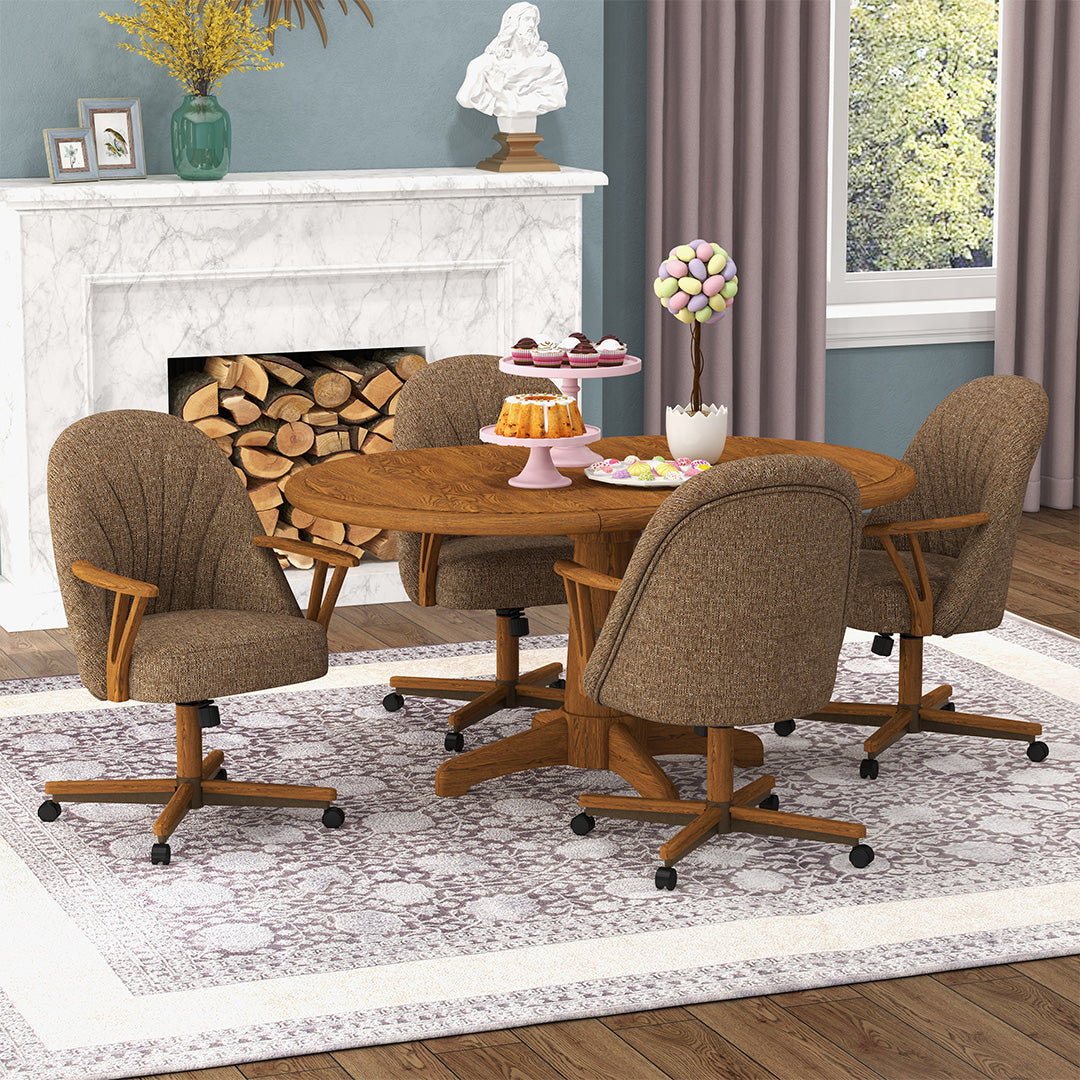




Swivel vs. Fixed Dining Chairs: Which Is Better?

Compare comfort, stability, mobility, floor compatibility, space requirements, and everyday use to determine which dining chair is right for your home.
When outfitting a dining room, one of the most important decisions is selecting the right seating. However, neither a fixed chair nor a caster swivel tilt dining chair is automatically best for every user.
A fixed chair may offer stationary stability, simpler operation, a smaller footprint, and fewer flooring considerations. By comparison, a caster chair may offer easier repositioning, directional movement, controlled tilt, less need to lift or drag the chair, and greater flexibility during longer meals and activities. Ultimately, the better choice depends on the intended user, room layout, flooring, table clearance, and how the dining space is used.

Evaluating Fixed Dining Chairs
Traditional fixed dining chairs vary greatly in quality, dimensions, cushioning, back support, durability, and comfort. A well-built fixed chair generally remains stationary when properly placed, which may suit users who prefer limited chair movement during sitting and standing. Because they do not require extra space for rotation or rolling, fixed chairs are often an excellent choice for smaller rooms or tighter table arrangements.
Evaluating Caster Swivel Tilt Dining Chairs
For households that use the dining table for extended gatherings, these chairs offer unique functional benefits. They are designed to provide controlled caster movement that may make repositioning easier, depending on the flooring, caster design, and intended user.
The tilt mechanism allows controlled backward movement as the user leans back, rather than holding the chair in one completely fixed position. This is paired with a 360-degree rotation, which allows users to turn and engage in conversation naturally.
Chromcraft uses the phrase "Easy In. Easy Out." to describe the ability to rotate and reposition the chair more easily around the dining table. Individual results depend on the user, flooring, room layout, and chair setup.
Quality swivel, tilt, and caster components should be engineered and tested for their intended residential use. Customers should always follow the specific model’s assembly, inspection, maintenance, and weight-capacity instructions.
Chromcraft’s Engineering Approach
Selected Chromcraft models incorporate a patented multi-layer seat support system using multiple foam layers with complementary support characteristics working together to provide welcoming surface comfort with deeper underlying support. The layered construction is designed to balance welcoming surface comfort with deeper underlying support during extended sitting. The patent applies specifically to the seat-support construction, not to the swivel, tilt, or caster functions.
Comparing Features for Everyday Living
|
Consideration |
Fixed Dining Chair |
Caster Swivel Tilt Dining Chair |
|
Stationary Stability |
Generally remains in a fixed position once placed. This may suit users who prefer a chair that does not move during sitting or standing. |
The chair is designed to move through caster, swivel, and tilt functions. The intended user should be comfortable controlling these movements during entry, exit, and repositioning. |
|
Repositioning Around the Table |
Usually requires the chair to be lifted, slid, or pulled away from the table. The amount of effort depends on the chair’s weight and flooring. |
Casters may make it easier to move toward or away from the table without lifting or repeatedly sliding the chair. |
|
Turning While Seated |
The user generally turns the upper body, shifts position, or moves the entire chair to face another direction. |
A 360-degree swivel allows the user to change direction while seated without moving the entire chair. |
|
Ability to Change Sitting Position |
Depends primarily on the chair’s back shape, seat dimensions, cushioning, and flexibility. |
In addition to seat and back support, the tilt mechanism allows controlled backward movement as the user leans back. |
|
Comfort During Extended Sitting |
Can be comfortable when properly sized and well cushioned, but the sitting position generally remains more fixed. |
Swivel and tilt provide additional ways to change position. Overall comfort still depends on seat dimensions, cushion construction, back design, arm support, and the intended user. |
|
Ease of Entering and Leaving the Table |
The chair may need to be slid or repositioned to create enough space for entry and exit. |
Swivel and caster movement may make it easier for some users to turn away from the table and reposition the chair. Chromcraft refers to this benefit as “Easy In. Easy Out.” Suitability depends on the user and flooring. |
|
Floor Compatibility |
Performance depends on the chair glides, chair weight, and floor surface. Improper glides may scratch or drag on some floors. |
Performance depends on the caster type, floor surface, rugs, and flooring transitions. Customers should confirm compatibility with their specific flooring. |
|
Use on Area Rugs |
Performance depends on rug stability, thickness, leg design, and whether the chair remains level. |
Caster movement may be affected by rug thickness, soft pile, raised edges, or transitions between flooring surfaces. |
|
Space Requirements |
Often requires less clearance because the chair does not rotate or roll in multiple directions. |
May require additional clearance for rotating the chair and caster movement around the table. |
|
Arm and Table Clearance |
Armchairs must be checked to ensure the arms fit beneath or beside the table apron. |
The same clearance requirements apply, with additional space needed for rotation and repositioning. |
|
Maintenance |
Requires periodic inspection of joints, fasteners, glides, upholstery, and cushioning. |
Requires the same general care, plus periodic inspection of casters, swivel components, tilt mechanisms, and fasteners. |
|
Typical Strengths |
Simplicity, stationary positioning, smaller space requirements, and broad style and price options. |
May provide easier repositioning, seated turning, controlled tilt movement, and greater flexibility during extended use. |
|
May Be Best For |
Users who prefer stationary seating, have limited room, use thick rugs, or want a simpler chair design. |
Users who value easier repositioning, seated turning, controlled tilt, and flexibility during extended meals, conversation, games, or hobbies. |
Neither design is universally better; the best choice depends on the intended user, room, flooring, table clearance, and daily activities.

Who Should Choose Which?
Every household uses the dining room differently. The following guidelines summarize which chair type may be better suited to different room layouts, flooring conditions, and everyday activities.
A fixed dining chair may be preferable when:
-
The user prefers a chair that generally remains stationary.
-
The room has limited space.
-
The flooring or rug is not well-suited to casters.
-
The user prefers simpler operation without rotation, tilt, or rolling movement.
-
Stationary positioning is more important than easier repositioning.
A caster swivel tilt chair may be preferable when:
-
The user values easier movement toward and away from the table.
-
Turning while seated is useful.
-
The chair is used for long meals, conversation, games, or hobbies.
-
The room provides enough clearance for rotation and caster movement.
-
The flooring is compatible with the caster design.
-
The intended user is comfortable controlling rotation, tilt, and caster movement.
Frequently Asked Questions
Q: Are swivel dining chairs better than fixed dining chairs?
A: There is no single answer. The better choice depends on the intended user, room layout, flooring, table clearance, and how the dining space is used.
Both chair types offer different advantages. The better choice depends on how the dining space is used and the needs of the intended user.
Q: What is the difference between swivel, tilt, and caster functions?
A: These three features serve different purposes.
-
Swivel allows the chair to rotate while the user remains seated.
-
Tilt allows controlled backward movement as the user leans back.
-
Casters allow the chair to roll across compatible flooring surfaces.
Together, these functions provide different types of movement, but each should be evaluated separately when comparing dining chairs.
Q: Are fixed dining chairs more stable than caster chairs?
A: A fixed dining chair generally remains stationary once positioned, while a caster chair is intentionally designed to move. Neither design is universally better. The intended user should feel comfortable with the chair's movement characteristics and choose the option that best fits the room, flooring, and everyday use.
Q: Can caster chairs be used on hardwood floors or area rugs?
They may be suitable for many residential flooring surfaces, but performance depends on several factors, including:
-
caster design
-
floor finish
-
rug thickness and pile
-
rug edges
-
flooring transitions
Customers should review both the chair manufacturer's recommendations and the flooring manufacturer's care guidance.
Q: How much space does a caster chair need?
A caster dining chair may require additional clearance than a fixed chair because it is designed to rotate and move.
Before purchasing, consider:
-
table-apron clearance
-
distance between chairs
-
room size
-
nearby walls or furniture
-
flooring conditions
Adequate clearance allows the chair to rotate and reposition without contacting nearby furniture or restricting normal movement.
Q: What is Chromcraft's patented multi-layer seat support system?
A: Selected Chromcraft models incorporate a patented multi-layer seat support system.
Rather than relying on one uniform foam layer, the construction uses multiple foam layers with complementary support characteristics.
The layered construction is designed to balance welcoming surface comfort with deeper underlying support during extended sitting.
The patented feature relates specifically to the seat-support construction rather than to the swivel, tilt, or caster functions.
Q: Which type of dining chair is right for me?
The answer depends on how you use your dining space.
A fixed chair may be appropriate for users who prefer a chair that generally remains stationary and requires minimal movement.
A caster chair may be a better choice for households that value easier repositioning, seated turning, controlled tilt, and flexibility during extended meals, conversations, games, hobbies, or other everyday activities.
When comparing models, consider the complete seating system, including seat dimensions, cushion construction, back design, arm support, movement features, flooring compatibility, and the needs of the intended user.
Whenever possible, the intended user should personally experience both chair types before making a final decision.
Final Thoughts
Neither a fixed dining chair nor a caster chair is automatically the better choice. The best option depends on the intended user, room layout, flooring, table clearance, and how the dining space is used.
With roots dating back to 1908, Chromcraft has a long history in American furniture manufacturing and seating engineering. For nearly five decades, the company has specialized in caster swivel tilt dining seating designed around comfort, movement, and everyday living.
When comparing dining chairs, consider the complete seating system—including seat dimensions, back design, arm support, movement features, cushion construction, flooring compatibility, and the needs of the intended user.
—
Ready to Compare Dining Chairs?
Explore Chromcraft's Dining Chair Collections to compare dimensions, upholstery options, movement features, and model-specific designs. You can also use our Dealer Locator to experience selected models in person and determine which chair best fits your home and everyday lifestyle.