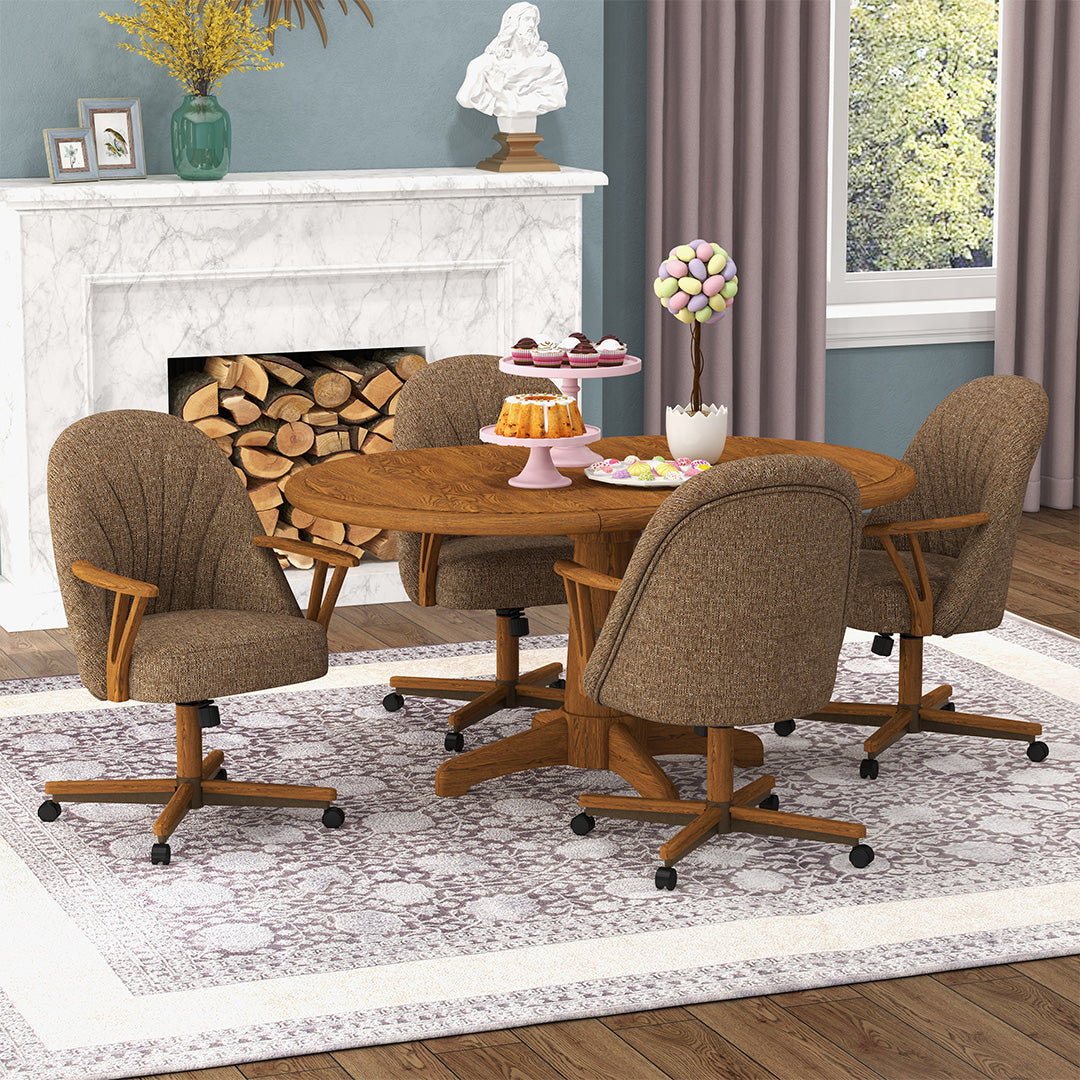




Best Dining Chairs for Long Sitting: Features to Look For

Learn which seat dimensions, cushioning, back support, armrests, swivel, tilt, and caster features matter when choosing a dining chair for long meals and extended sitting.
For many homeowners, comfort, support, and ease of movement are important priorities when choosing dining chairs for extended everyday use. However, the best dining chair for extended sitting is not necessarily the softest or most heavily padded chair. Comfort depends on how seat height, seat depth, cushioning, back support, armrests, and movement features work together for the intended user.
Ergonomic seating guidance commonly emphasizes appropriate seat dimensions, back support, arm support, and the ability to vary sitting position. Although most formal research focuses on workplace seating rather than dining chairs, these considerations provide a useful framework for evaluating a chair intended for extended sitting. Dining chairs serve different purposes than office chairs, but many ergonomic seating principles remain relevant when evaluating comfort during extended sitting.
With roots dating back to 1908, Chromcraft has a long history in American furniture manufacturing and seating engineering. For nearly five decades, the company has specialized in caster swivel tilt dining seating, building chairs designed for how modern families actually live.
8 Features That Affect Long-Sitting Comfort
The best dining chair for long meals or extended sitting is not necessarily the softest chair. Comfort depends on how the chair fits the intended user and how its seat, back, arms, movement features, and overall construction work together.
Before comparing dining chairs, evaluate the following eight features as a complete seating system rather than as isolated characteristics:
#1 Proper Seat Height
Seat height affects how comfortably a person can sit at the table and how easily they can place their feet on the floor.
-
When seated, the user’s feet should rest comfortably on the floor, with the knees positioned at or near hip level.
-
A seat that is too low may create a deeper knee angle and require more effort when standing.
-
A seat that is too high may leave the feet without adequate support.
The correct seat height also depends on the dining table. There should be enough room between the top of the seat and the underside of the table or table apron for comfortable leg movement.
Before purchasing, compare the chair’s seat height with:
-
the intended user’s height and leg length;
-
the table height;
-
the table-apron clearance;
-
the thickness of the seat cushion under normal use.
A chair should be evaluated based on the person who will use it most often, rather than relying on one standard measurement for every household.
Why This Matters: A properly fitted seat height can contribute to comfortable everyday use and help the user maintain comfortable foot contact and leg positioning during extended sitting.
#2 Appropriate Seat Depth
Seat depth is the distance from the front edge of the seat to the backrest. It is one of the most frequently overlooked dining-chair measurements.
-
A seat that is too deep may prevent a shorter user from comfortably reaching the backrest. The person may sit forward without back support, or the front edge of the cushion may press behind the knees.
-
A seat that is too shallow may provide less support beneath the thighs, particularly for taller users.
When testing seat depth:
-
sit with the back comfortably against the backrest;
-
keep the feet supported on the floor;
-
check that there is a small amount of space between the front edge of the seat and the back of the knees;
-
confirm that the user does not need to slide forward to place both feet securely.
What to Check Before Buying: Appropriate seat depth allows the user to comfortably use both the seat cushion and the backrest as intended.
#3 Adequate Seat Width
Seat width affects comfort, freedom of movement, and the amount of personal space available while sitting. The seat should be wide enough for the intended user to sit comfortably without feeling restricted by the armrests or side structure. At the same time, an excessively wide chair may require more dining-room space and may reduce the number of chairs that fit around the table.
Consider:
-
the user’s body dimensions;
-
the distance between the armrests;
-
the overall chair width;
-
the spacing between chairs at the table;
-
the clearance required for swivel movement, if applicable.
For dining armchairs, measure both the interior seat width and the total outside width of the chair.
Why This Matters: A chair can have good cushioning but still feel uncomfortable if the seat or arm spacing is too narrow for the user.
#4 Balanced Cushion Construction
Comfort comes from how the cushion works together with seat dimensions, back support, and the user's sitting position—not from foam thickness alone. The thickest or softest cushion is not always the most comfortable choice for extended sitting. Very soft cushioning may feel comfortable initially but can allow the user to sink too deeply. A very firm cushion may provide support but feel less welcoming during longer meals or activities. A well-designed cushion should balance surface comfort with deeper support.
Selected Chromcraft models incorporate a patented multi-layer seat support system. Multiple foam layers with complementary support characteristics are designed to balance welcoming surface comfort, deeper underlying support, and resilience during extended sitting. Unlike a single block of uniform foam, a layered seat system can be engineered so that different foam layers are designed to provide complementary support characteristics.
When comparing cushions, consider:
-
the number and type of support layers;
-
how the seat feels after more than a few minutes;
-
whether the user feels adequately supported rather than sinking through the cushion;
-
whether the cushion returns to shape after use;
-
whether the patented construction applies to the specific model being considered.
What to Check Before Buying: Cushion quality affects not only the first impression of comfort but also how the chair feels throughout a long meal, conversation, or game night.
#5 Supportive Back Design
A dining-chair backrest should provide comfortable back contact without forcing every user into one rigid position. The shape, height, angle, padding, and flexibility of the backrest all affect how the chair feels during extended use.
A supportive back design should allow the user to:
-
sit with comfortable contact against the backrest;
-
maintain a relaxed position at the table;
-
change position occasionally;
-
lean back without feeling that the backrest is too hard or too far away.
Back shape should be considered together with seat depth. Even a well-designed backrest will not provide useful back contact if the seat is too deep for the user to reach it comfortably. Some dining chairs remain entirely fixed, while caster swivel tilt models allow controlled movement as the user changes position. Movement can add flexibility, but the quality of the backrest and cushion remains equally important.
Why This Matters: Long-sitting comfort depends on how the seat and backrest work together for the intended user.
#6 Arm Support and Table Clearance
Armrests can make a dining chair feel more supportive during meals, conversations, and other activities around the table. They may provide a place to rest the forearms, additional lateral support, an additional contact point when the user sits down or stands up, and a more relaxed seating position during longer activities.
However, armrests must also fit the dining table. Before purchasing, measure:
-
the height of the armrests;
-
the distance from the floor to the underside of the table;
-
the height and depth of the table apron;
-
the total chair width;
-
the amount of space between adjacent chairs.
If the armrests do not clear the table or apron, the chair may not move close enough to the table for comfortable dining. For caster chairs, the intended user should also confirm that the chair responds predictably on the planned flooring surface when pressure is applied to the armrests.
What to Check Before Buying: Armrests can improve comfort, but only when their height, width, and relationship to the table are appropriate.
#7 Swivel and Controlled Tilt Movement
Movement features can make a dining chair more adaptable during extended use.
Swivel: A swivel function allows the user to change direction while remaining seated. This can be helpful when speaking with people seated in different parts of the room, moving away from the table, interacting with different areas around the table, or using the dining area for games or conversation. Swivel movement may reduce the need to move the entire chair each time the user changes direction.
Tilt: A tilt mechanism allows controlled backward movement as the user leans back, rather than holding the chair in one completely fixed position. This gives the user another way to change sitting position during longer meals, conversations, card games, or other activities. The tilt should feel smooth, controlled, appropriate for the intended user, and stable throughout its intended range of movement.
Swivel and tilt do not automatically make every chair comfortable. They work best when combined with appropriate seat dimensions, cushioning, back support, and arm support.
Why This Matters: The ability to change position can contribute to a more flexible seating experience during extended use.
#8 Caster and Floor Compatibility
Casters can make a dining chair easier to reposition without repeatedly lifting or dragging the chair. However, caster performance depends on the type of wheel and the flooring surface. Customers should consider:
-
Hardwood
-
Laminate
-
Tile
-
Stone
-
Vinyl
-
Area rugs
-
Carpet
Different caster designs perform differently depending on the flooring surface, and no caster should automatically be described as suitable for every surface. Thick rugs, deep carpet pile, uneven surfaces, or raised transitions may make movement more difficult. Very smooth floors may create a different movement experience than carpeted surfaces.
Before purchasing:
-
confirm the caster type used on the specific chair;
-
review the chair manufacturer’s floor guidance;
-
review the flooring manufacturer’s care recommendations;
-
test the chair in the intended room when possible;
-
confirm that the user can control the chair during sitting, standing, turning, and repositioning.
Why This Matters: Caster mobility is useful only when the chair, flooring, room layout, and intended user are compatible.

Match the Chair to the Intended User
No single feature determines whether a dining chair will be comfortable for long sitting. The best results come from matching the chair’s dimensions, cushion construction, back design, arm support, movement features, and caster type to the intended user and dining environment.
When evaluating a chair, consider the user's height, proportions, seating preferences, ability to control movement, available space, and intended activities. For example, armrests can provide an additional contact point when sitting or standing, but the intended user should confirm that the chair remains controllable on the planned flooring surface. Likewise, a chair with swivel or caster movement may not be the right choice if the user prefers stationary seating or if the flooring limits controlled movement. Some homeowners prefer swivel dining chairs for dining rooms used for meals, conversation, games, and other everyday activities. The most appropriate dining chair is the one that best matches the intended user, dining table, room layout, flooring, and everyday activities.
Which Features Matter Most for Your Activities?
|
Activity |
Important Chair Features |
|
Long Meals |
Proper seat height, appropriate seat depth, supportive back design, balanced cushion construction |
|
Game Nights & Puzzles |
Adequate seat width, arm support and table clearance, swivel movement, resilient cushioning |
|
Coffee & Conversation |
Controlled tilt movement, swivel movement, ability to change position naturally |
|
Reading & Hobbies |
Proper seat fit, supportive back contact, balanced cushioning, ability to change position naturally |
|
Working from the Dining Table |
Appropriate seat height, supportive back contact, resilient cushioning, and table compatibility |
|
Multipurpose Everyday Use |
Caster and floor compatibility, durable construction, ergonomic fit across users |
How Chromcraft Brings These Comfort Features Together
Chromcraft has specialized in caster swivel tilt dining seating for nearly five decades. The company combines multiple seating features that work together as a complete seating system for extended everyday use:
-
Nearly five decades of caster swivel tilt specialization
-
Integrated caster, swivel, and controlled tilt functions
-
Patented multi-layer seat support on applicable models
-
Model-specific dimensions and construction designed for real users
-
Warranty and replacement-part support where applicable
Because specifications vary by collection and model, customers should compare seat height, seat depth, overall width, arm height, movement features, weight capacity, flooring compatibility, and warranty information before choosing a chair.

Frequently Asked Questions
Q1. What makes a dining chair comfortable for long sitting?
A: Comfort depends on how several features work together rather than on cushioning alone. Important considerations include appropriate seat height, seat depth and width, balanced cushion construction, supportive back design, arm support, the ability to change sitting position, and movement features such as swivel, tilt, and casters where appropriate. The most comfortable chair is one that fits the intended user, works with the dining table, and remains supportive throughout extended use.
Q2. Is a softer dining chair always more comfortable?
A: Not necessarily. A very soft cushion may feel comfortable at first but allow the user to sink too deeply over time, while an overly firm cushion may feel less welcoming. Long-term comfort comes from balancing surface comfort with deeper support, together with proper seat dimensions and back design.
Q3. How should I test a dining chair before buying it?
A: Whenever possible, the intended user should sit in the chair for several minutes rather than relying on a first impression. Check that:
-
both feet rest comfortably on the floor;
-
the back reaches the backrest naturally;
-
the seat does not press behind the knees;
-
the armrests clear the table;
-
swivel, tilt, and caster movement (if included) feel comfortable and controllable;
-
the chair fits both the user and the dining table.
Q4. Are dining chairs with arms better for long meals?
A: Armrests can improve comfort by providing additional support during meals, conversation, and extended sitting. However, they should also fit beneath or beside the dining table. Before purchasing, compare arm height, chair width, table clearance, and available space around the table.
Q5. Are caster swivel tilt dining chairs suitable for every user?
A: No. No single chair design is ideal for everyone. Caster swivel tilt chairs may be beneficial for users who value easier repositioning, seated turning, and flexibility during long meals or other activities. However, users who prefer a chair that generally remains stationary or have limited space or flooring unsuitable for casters may prefer a traditional fixed dining chair.
Q6. What is Chromcraft's patented multi-layer seat support system?
A: Selected Chromcraft models incorporate a patented multi-layer seat support system. Instead of relying on a single foam layer, the seat uses multiple foam layers with complementary support characteristics designed to balance welcoming surface comfort with deeper underlying support during extended sitting. The patent applies specifically to the seat-support construction, not to the swivel, tilt, or caster functions.
Q7. Why is Chromcraft different from a typical swivel dining chair?
A: Chromcraft combines multiple seating features rather than relying on swivel movement alone. Depending on the model, these may include caster mobility, 360-degree swivel, controlled tilt, supportive upholstered seating, model-specific dimensions, and a patented multi-layer seat support system. With nearly five decades of specialization in caster swivel tilt dining seating, Chromcraft continues to develop seating designed around comfort, movement, and everyday living.
Q8. What is the best dining chair for long meals and family gatherings?
A: The best dining chair is one that fits the intended user, works with the dining table and room, remains comfortable beyond the first few minutes, and supports the activities that take place around the table. Consider seat fit, cushion construction, back design, arm support, movement features, flooring compatibility, and overall chair quality before making a decision.
Final Thoughts
The best dining chair for long sitting is not simply the softest chair or the one with the thickest cushion. Long-term comfort depends on how seat fit, cushion construction, back design, arm support, movement features, flooring compatibility, and the intended user's needs work together.
With roots dating back to 1908, Chromcraft has a long history in American furniture manufacturing and seating engineering. For nearly five decades, the company has specialized in caster swivel tilt dining seating designed around comfort, movement, and everyday living.
—
Ready to Find the Right Dining Chair?
Explore Chromcraft's Dining Chair Collections to compare seat dimensions, movement features, upholstery options, and model-specific designs. You can also visit an authorized Chromcraft dealer to experience selected models in person and determine which chair best fits your home and everyday activities.
Explore Dining Chair Collections