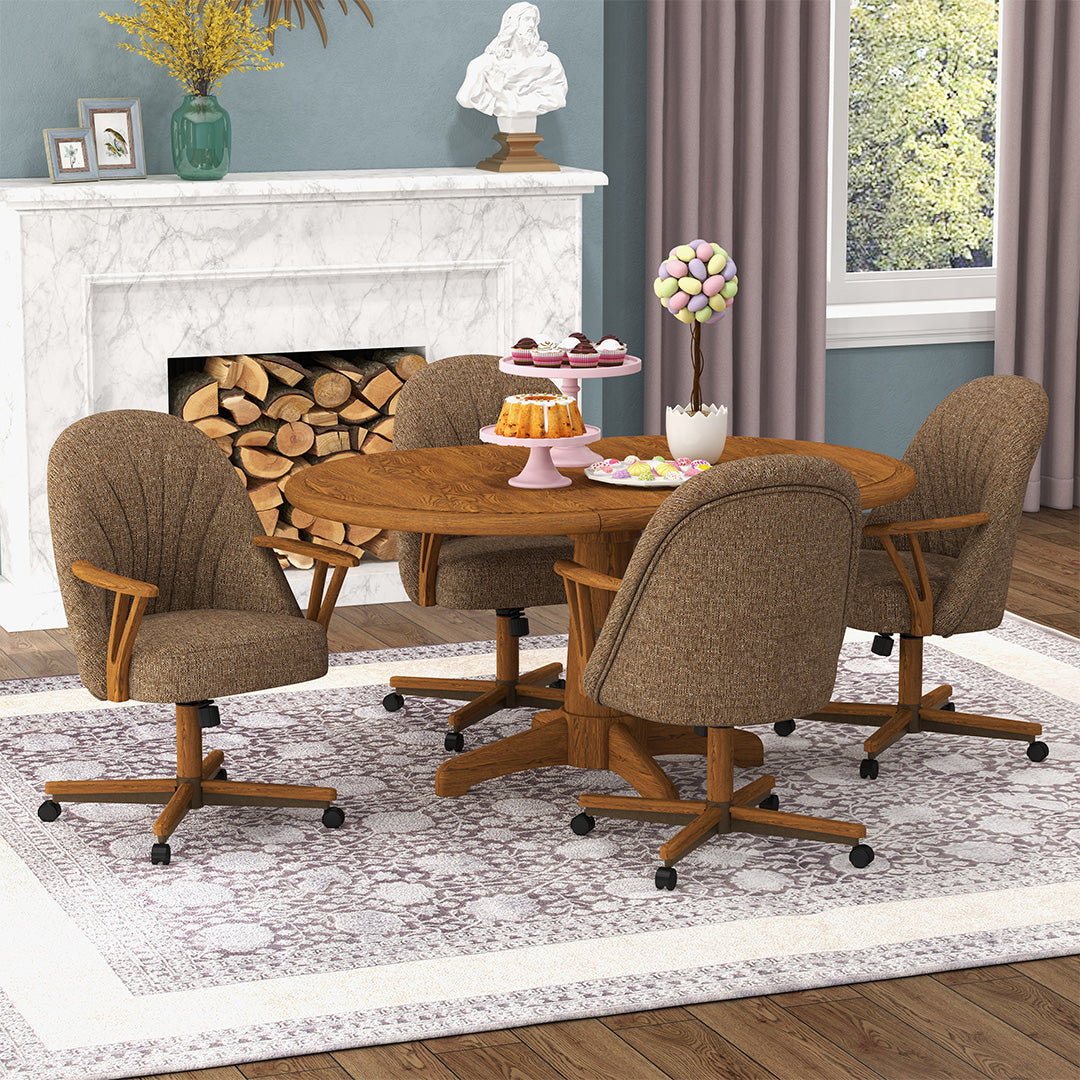




What Makes a Dining Chair Comfortable? Key Features That Matter Most

Learn how seat fit, cushion support, back design, arm support, movement features, and construction work together as a complete seating system.
When choosing dining room furniture, appearance often gets the most attention. However, once family dinners stretch into conversations, game nights, holiday gatherings, or morning coffee, comfort quickly becomes the feature that matters most.
A comfortable dining chair is not defined by softness alone. Long-sitting comfort depends on how the seat fits the user, how the cushion supports weight over time, how the back and arms provide contact, and whether the chair allows controlled changes in position.
General ergonomic seating guidance commonly considers seat fit, back support, arm support, and the ability to vary sitting position. Most formal ergonomic guidance focuses on workplace seating rather than dining chairs, but these principles provide a useful framework for evaluating comfort during extended sitting.
With roots dating back to 1908, Chromcraft has a long history in American furniture manufacturing and seating engineering. For nearly five decades, the company has specialized in caster swivel tilt dining seating. The following design and engineering principles help explain why one dining chair may remain more comfortable than another during extended use.

8 Comfort Elements of a Complete Seating System
Comfort should be viewed as a complete seating system rather than a collection of individual features. The following eight elements provide a practical framework for evaluating how dining-chair design may influence comfort during extended everyday use:
#1 Seat Fit: Height, Depth, Width, and Table Clearance
A dining chair may have generous cushioning but still feel uncomfortable if its dimensions do not fit the intended user or dining table.
-
Seat height affects foot contact, leg position, and the relationship between the user and the tabletop.
-
Seat depth affects whether the user can comfortably reach the backrest without the front of the seat pressing behind the knees.
-
Seat width affects usable space between the armrests and the amount of room the chair occupies around the table.
-
Table clearance determines whether the user can sit close enough to the table without the armrests or legs contacting the tabletop or apron.
These dimensions should be evaluated together. Appropriate seat fit provides the foundation for the cushion, backrest, armrests, and movement features to function as intended.
#2 Multi-Layer Cushion Support
Initial softness and sustained support are different considerations. A cushion made from one uniform foam layer provides one general support response, while a layered construction can use foam layers with complementary characteristics to create a more progressive seating feel.
Selected Chromcraft models incorporate a patented multi-layer seat support system. Rather than relying on one uniform foam layer, the construction uses multiple foam layers designed to balance welcoming surface comfort with deeper underlying support and resilience during extended sitting. The patented construction applies only to selected Chromcraft models.
#3 Back Shape and Contact
A dining chair should provide comfortable back contact throughout a meal, conversation, or other extended activities around the table. Back support should encourage natural contact rather than forcing every user into one sitting posture. However, a supportive back design is about much more than just adding extra padding.
A comfortable back shape depends on how several design elements work together, including:
-
backrest height
-
backrest angle
-
contour and shape
-
firmness of the support
-
relationship between the backrest and seat depth
-
the user's body size and preferred sitting position
A chair with generous padding may still feel uncomfortable if the user cannot comfortably reach the backrest while keeping both feet supported on the floor. Likewise, a chair with an appropriate seat depth may still feel uncomfortable if the back angle or shape does not provide comfortable contact. For this reason, the seat dimensions and backrest design should be evaluated together, rather than as separate features.
#4 Arm Support and Table Fit
Armrests can provide a comfortable place to rest the forearms and an additional contact point when entering or leaving the chair. Their usefulness depends on the intended user, armrest height, usable space between the arms, chair width, table clearance, and the way the chair responds when pressure is applied.
Before choosing an armchair, compare:
-
armrest height;
-
usable width between the arms;
-
total chair width;
-
tabletop and table-apron clearance;
-
spacing between adjacent chairs; and
-
the chair’s response to pressure on the intended flooring.
If the armrests contact the tabletop or apron, the chair may not move close enough to the table for comfortable positioning.
Why This Matters
Armrests contribute most effectively when they fit both the intended user and the dining table.
#5 Freedom to Change Position
Remaining in one sitting position for an extended period can become less comfortable over time. A comfortable dining chair should allow the user to make natural posture adjustments throughout meals, conversations, games, hobbies, and other activities around the table.
Changing position does not necessarily require standing up. Small adjustments—such as leaning back slightly, turning toward another person, or repositioning closer to the table—can help create a more adaptable seating experience.
The ability to change position should be viewed as one part of the overall seating system. It works together with proper seat fit, supportive back design, arm support, balanced cushion construction, and the intended user's preferences.
Why This Matters
A comfortable dining chair should support natural movement rather than encourage the user to remain in one fixed sitting position throughout extended use.
#6 Swivel and Controlled Tilt
Although swivel and tilt are often mentioned together, they perform different functions and should be evaluated separately.
Swivel
A swivel function allows the chair to rotate while the user remains seated. Instead of moving the entire chair, the user can simply turn toward another person or activity. This can be helpful during family meals, conversations, games, hobbies, or other multipurpose dining-room activities.
Controlled Tilt
A tilt mechanism allows controlled backward movement as the user naturally leans back. Rather than keeping the chair in one completely fixed position, tilt provides another way to adjust sitting posture during extended use. Dining-chair tilt is intended to provide controlled backward movement within its designed range—not the large-angle recline associated with a recliner.
How They Work Together
Swivel changes the direction the chair faces. Tilt changes the user's sitting posture.
Together, they provide additional flexibility during extended sitting. However, neither feature determines comfort by itself. Their effectiveness depends on how they work together with seat fit, back design, arm support, balanced cushion construction, and the overall seating system.
Why This Matters
Movement features are most effective when they complement the complete seating system rather than functioning as isolated features.
#7 Caster Mobility and Flooring Compatibility
Caster mobility does not make a dining chair softer or more supportive. Its purpose is to assist with everyday repositioning.
On compatible flooring, an appropriate caster design may reduce the need to repeatedly lift, slide, or pull the chair when moving toward or away from the table. Performance depends on the caster design, flooring surface, rugs, transitions, room layout, and intended user.
However, caster performance depends on many factors, including:
-
caster design and material;
-
hardwood, tile, laminate, vinyl, or stone flooring;
-
area rugs and carpet thickness;
-
flooring transitions;
-
room layout; and
-
the intended user's ability to control the chair.
No caster is suitable for every floor or every user. Customers should review both the chair manufacturer's recommendations and the flooring manufacturer's care guidance before purchase.
Why This Matters
Caster mobility contributes to comfort by making everyday repositioning easier—not by changing the cushion itself. Its effectiveness depends on matching the caster design to the flooring, room, and intended user.
#8 Long-Term Comfort Through Quality Construction
Comfort should not be evaluated only when a chair is new. Construction quality, materials, assembly, maintenance, and normal wear can all influence how the chair feels over time.
Long-term comfort depends on the quality of the complete seating system, including:
-
structural construction;
-
seat-support design;
-
swivel and tilt mechanisms (where applicable);
-
caster performance;
-
upholstery and cushion materials;
-
hardware and fasteners; and
-
proper assembly and routine maintenance.
As a chair ages, loose hardware, worn upholstery, compressed cushioning, or excessive movement in mechanical components may change how the chair feels during everyday use.
When comparing dining chairs, customers should consider more than initial appearance or softness. Reviewing construction quality, warranty coverage, replacement-part availability, and maintenance guidance can provide a better understanding of the factors that may influence the chair’s performance over time.
Why This Matters
Long-term comfort depends on maintaining the complete seating system—not simply on how the chair feels during the first few minutes after someone sits down.

The Chromcraft Difference
With roots dating back to 1908, Chromcraft has a long history in American furniture manufacturing and seating engineering. For nearly five decades, the company has specialized in caster swivel tilt dining seating designed around comfort, movement, and everyday living.
Depending on the model, Chromcraft brings together seat fit, supportive upholstery, arm support, swivel, controlled tilt, caster mobility, quality construction, and—on selected models—a patented multi-layer seat support system. These elements are designed to work together as one complete seating system for the many ways today’s dining rooms are used, including meals, conversations, games, hobbies, and family gatherings.
Frequently Asked Questions
Q: What makes a dining chair comfortable?
A: A comfortable dining chair is not defined by softness alone. Comfort depends on how seat fit, cushion support, back design, arm support, movement features, and overall construction work together for the intended user. A suitable chair is one that fits the intended user and provides an appropriate balance of support, contact, and movement during extended sitting.
Q: Is the softest dining chair always the most comfortable?
A: No. A very soft cushion may feel inviting initially but can allow the user to sink too deeply over time. A very firm cushion may provide support but feel less welcoming. Long-term comfort comes from balancing surface comfort with deeper underlying support, together with proper seat fit and back design.
Q: How do the seat and backrest work together?
A: The seat and backrest should be evaluated as one seating system. Seat height, seat depth, back shape, and back angle work together to influence how comfortably the user can maintain contact with both the seat and backrest. Even a well-padded chair may feel uncomfortable if the seat dimensions prevent the user from making comfortable contact with the backrest.
Q: Why is the ability to change position important during long sitting?
A: Remaining in one sitting position for an extended period may become less comfortable over time. The ability to make natural posture changes—such as turning, leaning back slightly, or repositioning—can create a more adaptable seating experience. Movement features work best when combined with proper seat fit, supportive back design, and balanced cushion construction.
Q: What is the difference between swivel and tilt?
A: Swivel and tilt perform different functions. Swivel allows the chair to rotate while the user remains seated, making it easier to turn toward different people or activities. Tilt allows controlled backward movement as the user naturally leans back. Together, they provide greater flexibility during extended sitting, but neither feature alone determines overall comfort.
Q: How do casters affect dining-chair comfort?
A: Casters do not make a chair softer or more supportive. Their benefit comes from making everyday repositioning easier on compatible flooring. Properly designed casters may reduce the need to repeatedly lift or drag the chair during meals, conversations, or other activities. Performance depends on the caster design, flooring type, room layout, and the intended user.
Q: Can one dining chair be comfortable for everyone?
A: No. Comfort is highly individual. A chair that feels comfortable for one person may not fit another because of differences in body size, seating preferences, table height, room layout, flooring, and intended use. The best dining chair is the one that fits the intended user and the environment where it will be used.
Q: What is Chromcraft's patented multi-layer seat support system?
A: Selected Chromcraft models incorporate a patented multi-layer seat support system. Instead of relying on one uniform foam layer, the construction uses multiple foam layers with complementary support characteristics designed to balance welcoming surface comfort with deeper underlying support during extended sitting. The patent applies specifically to the seat-support construction, not to the swivel, tilt, or caster functions.
Q: Why does Chromcraft describe comfort as a complete seating system?
A: Chromcraft believes that comfort is created by the way multiple design elements work together—not by any single feature alone. Depending on the model, the seating system may include proper seat dimensions, supportive back design, arm support, a patented multi-layer seat support system, swivel, controlled tilt, caster mobility, and quality construction. This integrated approach reflects Chromcraft’s view that dining-chair comfort should be evaluated as a complete seating system rather than as a single feature.
Experience the Difference Comfort Engineering Can Make
Choosing a dining chair involves more than selecting a style or fabric. Comfort during extended use depends on how seat fit, cushion construction, back design, arm support, movement features, flooring compatibility, and overall construction work together as a complete seating system.
Explore Chromcraft’s Dining Chair Collections to compare features, dimensions, upholstery options, and model-specific designs. You may also visit an authorized Chromcraft dealer to experience selected models in person and determine which chair best fits your home and everyday activities.
Explore Dining Chair Collections