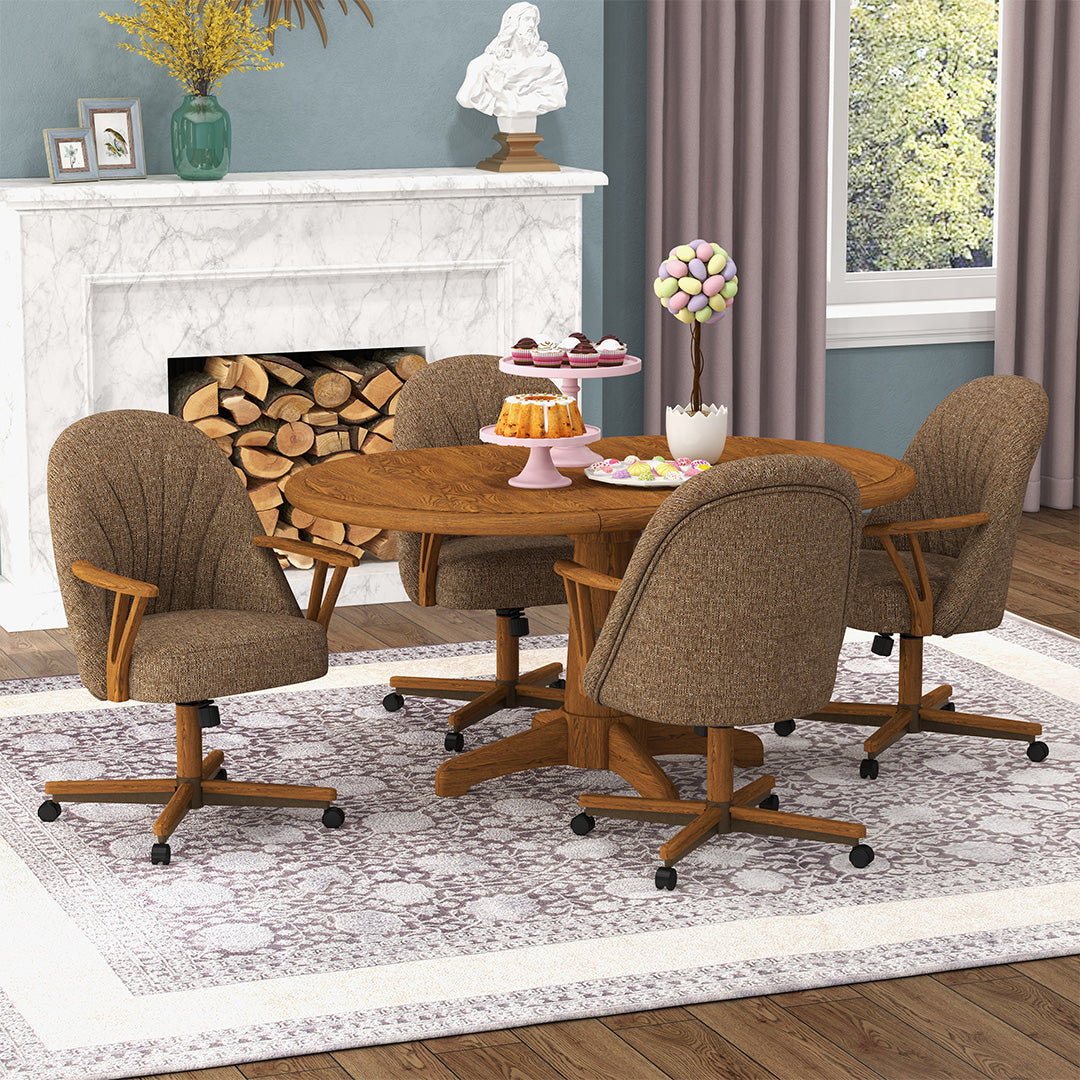




Buying Guide: How to Choose Dining Chairs for Aging Parents

Discover how seat fit, arm support, stability, controlled movement, and flooring compatibility affect everyday dining-chair usability for older adults.
According to the U.S. Census Bureau, approximately 10,000 Baby Boomers have been reaching age 65 each day, on average, since 2011. By 2030, every member of the Baby Boomer generation will be age 65 or older. As families evaluate everyday furniture for older parents, dining-chair fit, movement, flooring compatibility, and ease of use may become increasingly important considerations.
Families naturally gather around the dining table, but different chair types require different kinds of movement. A stationary dining chair generally needs to be lifted, pulled, or slid when moving toward or away from the table. Depending on the chair’s weight, flooring, glides, room layout, and intended user, this may require additional effort. A caster swivel tilt dining chair may make repositioning easier, but it also introduces movement that the user should be comfortable controlling.
This guide will help you determine whether a caster swivel tilt dining chair is appropriate for the intended user and home environment.

Important Suitability Considerations
A caster swivel tilt dining chair is not automatically the best option for every older adult. Because the chair can rotate, tilt, and move on casters, its suitability depends on the intended user, flooring, caster design, table clearance, room layout, and the amount of movement the user prefers.
A fixed dining chair may be preferable for someone who strongly prefers a stationary seating position during sitting and standing. A caster swivel tilt dining chair may be appropriate for someone who values seated turning, controlled tilt, and easier repositioning.
Whenever possible, the intended user should personally test:
-
sitting down;
-
standing up;
-
turning while seated;
-
using the tilt function;
-
moving toward and away from the table;
-
resting both feet comfortably on the floor;
-
checking armrest and table clearance; and
-
confirming predictable movement on the intended flooring.
When the user or family is uncertain about the appropriate chair type, they may also seek guidance from a caregiver or other appropriate professional familiar with the individual’s needs.
Essential Evaluation Criteria for Dining Chairs
To find a chair that truly fits a user's needs, families should look beyond aesthetics and evaluate specific functional measurements.
#1 Armrest Support and Table Clearance
Armrests can provide a comfortable place to rest the forearms and may be useful when entering or leaving the chair. However, the intended user should test how the chair responds when pressure is placed on the armrests, particularly when the chair includes swivel, tilt, or caster movement.
Families should measure:
-
armrest height;
-
table-apron clearance;
-
tabletop clearance;
-
usable space between the arms; and
-
total chair width.
The chair should move close enough to the table without the arms contacting the tabletop or apron, restricting legroom, or preventing comfortable positioning.
#2 Proper Seat Fit: Height, Depth, and Width
Seat dimensions should be evaluated in relation to the intended user.
Seat height: The user’s feet should rest comfortably on the floor while the user maintains comfortable contact with the seat and backrest.
Seat depth: The user should be able to sit against the backrest without the front edge of the seat pressing uncomfortably behind the knees.
Usable seat width: The space between the armrests should allow the intended user to sit comfortably without feeling restricted.
Families should also consider the chair’s total outside width and the amount of space available around the dining table.
#3 Cushion Construction and Support
Cushion comfort depends on more than foam thickness or density. Selected Chromcraft models incorporate a patented multi-layer seat support system that uses multiple foam layers with complementary support characteristics. The layered construction is designed to balance welcoming surface comfort with deeper underlying support and resilience during extended sitting.
Families should confirm whether the specific model being considered includes this patented construction.
#4 Caster Mobility and Flooring Compatibility
Casters may reduce the need to repeatedly lift or drag the chair when repositioning it. However, caster performance depends on caster design, flooring material, floor finish, carpet pile, area rugs, thresholds, and transitions between flooring surfaces.
Customers should review both the chair manufacturer’s recommendations and the flooring manufacturer’s care instructions. Whenever possible, the intended user should test how predictably and comfortably the chair moves on the flooring where it will be used.
#5 Swivel and Controlled Tilt
Swivel and tilt perform different functions. Swivel allows the user to change direction while remaining seated. Tilt allows controlled backward movement as the user naturally leans back.
The intended user should evaluate the amount, resistance, and feel of both movements. Depending on the model, tilt tension may be preset or adjustable. Customers should review the specific product features rather than assuming that every chair offers the same movement or adjustment range.
#6 Weight Capacity, Construction, and Maintenance
Review the manufacturer’s stated weight capacity and confirm that the intended user falls within the listed limit for the specific model.
Families should also consider:
-
frame and base construction;
-
hardware and fasteners;
-
upholstery-care requirements;
-
caster maintenance;
-
swivel and tilt components;
-
warranty coverage; and
-
current replacement-part availability.
Over time, hardware may loosen, upholstery may wear, cushioning may change, and moving components may require inspection or service. Customers should follow the manufacturer’s assembly, care, and maintenance guidance for the specific model.

Comparing Dining Chair Options
To help you make an objective decision, use this comparison table to understand how a standard static chair differs from a caster swivel tilt dining chair.
|
Feature Category |
Stationary Dining Chair |
Caster Swivel Tilt Dining Chair |
|
Seating Position |
Provides a generally stationary seating position when properly placed. |
Allows swivel, controlled tilt, and caster movement, depending on the model. |
|
Repositioning |
Usually requires the chair to be lifted, pulled, or slid toward or away from the table. |
Casters may make repositioning easier on compatible flooring. |
|
Turning While Seated |
The user generally turns the upper body, shifts position, or repositions the chair. |
Swivel allows the user to change direction while remaining seated. |
|
Entering and Leaving the Table |
The chair normally needs to be moved away from the table before the user sits down or stands up. |
Swivel and caster movement may allow some users to turn away from the table and reposition more easily. |
|
Flooring Compatibility |
Depends on chair glides, protective pads, chair weight, flooring material, and how the chair is moved. |
Depends on caster design, flooring material, floor finish, carpet pile, area rugs, thresholds, and flooring transitions. |
|
Movement Control |
Offers fewer moving components and a more fixed seating experience. |
The user should be comfortable managing the swivel, tilt, and caster movement. |
|
Space Requirements |
Requires sufficient room to pull or slide the chair away from the table. |
Requires sufficient clearance for swivel, tilt, caster movement, and turning away from the table. |
|
Who It May Suit |
Users who prefer stationary seating and simpler movement. |
Users who value seated turning, controlled tilt, and easier repositioning. |
|
What to Test Before Purchase |
Seat height, depth and width, armrest height, table clearance, backrest contact, cushioning, stability, and effort required to reposition the chair. |
Seat height, depth and width, armrest height, table clearance, backrest contact, cushioning, sitting down, standing up, swivel, tilt, caster movement, and flooring compatibility. |
Frequently Asked Questions
Q: What should families consider when choosing a dining chair for an older parent?
A: Families should consider the intended user’s seat-fit needs, preferred level of movement, armrest height, table clearance, flooring, room layout, cushion support, backrest design, weight capacity, construction, maintenance requirements, and warranty coverage. Whenever possible, the intended user should personally test both stationary and movable chair options before purchase.
Q: What seat height is best for an older adult?
A: The appropriate seat height depends on the intended user’s body dimensions and preferences. Ideally, the user’s feet should rest comfortably on the floor while the user maintains comfortable contact with the seat and backrest. The intended user should personally test sitting down and standing up rather than selecting a chair based on seat height alone.
Q: Should an older adult’s dining chair have arms?
A: Armrests can provide a place to rest the arms and may be useful when entering or leaving the chair. However, armrest height, strength, table clearance, and the chair’s response to pressure should all be evaluated. The arms should allow the chair to move close enough to the table without scraping the tabletop or apron or restricting comfortable positioning.
Q: Are caster chairs appropriate for every older adult?
A: No. A caster swivel tilt dining chair is not automatically the best option for every older adult. Suitability depends on the intended user, flooring, room layout, caster design, table clearance, and preference for stationary or movable seating. For some users, a fixed dining chair may be the more appropriate choice.
Q: How should the tilt function be evaluated?
A: The intended user should test how far the chair tilts, how much resistance it provides, how smoothly it moves, and how it returns toward the upright position. Tilt characteristics vary by model, and not every mechanism has adjustable tension. A fixed chair may be preferable for someone who strongly prefers a stationary seating position.
Q: Can rolling dining chairs be used on area rugs?
A: Performance varies by rug thickness, pile, edge design, backing, and caster type. Thin, firmly secured, low-pile rugs may work better than thick or loose rugs. Customers should confirm compatibility, test the chair on the intended surface, and review both the chair and flooring manufacturers’ recommendations.
Q: What weight capacity should be considered?
A: Review the manufacturer’s stated weight capacity for the specific model and confirm that it is appropriate for the intended user. Weight capacity should be considered together with construction, assembly, condition, maintenance, and intended residential use.
Q: How much clearance is needed between the arms and the dining table?
A: There should be enough clearance for the chair to move close to the table without the armrests contacting the tabletop or table apron, restricting legroom, or preventing comfortable positioning. Because table-apron depth and chair-arm height vary, families should measure both the chair and table before purchase.
Q: How should a family test a dining chair before buying it?
A: Whenever possible, the intended user should personally test the chair on flooring similar to the surface where it will be used. The evaluation should include:
-
sitting down and standing up;
-
feet resting comfortably on the floor;
-
seat height, depth, and usable width;
-
comfortable backrest contact;
-
cushion support after more than a few minutes;
-
armrest height and usable space between the arms;
-
tabletop and table-apron clearance;
-
turning while seated;
-
controlled tilt movement;
-
movement toward and away from the table; and
-
predictable caster performance on the intended flooring.
The Chromcraft Difference
Once you have determined the appropriate chair type, dimensions, movement characteristics, and flooring compatibility for the intended user, you can compare Chromcraft’s available dining-chair options.
With roots dating back to 1908, Chromcraft has a long history in American furniture manufacturing and seating engineering. For nearly five decades, the company has specialized in caster swivel tilt dining seating designed around comfort, movement, and everyday living.
Depending on the model and intended user, the combination of swivel, controlled tilt, arm support, and caster mobility may make it easier to turn away from the table and reposition the chair. Chromcraft describes this practical design concept as “Easy In. Easy Out.”
Selected Chromcraft models incorporate a patented multi-layer seat support system. Instead of relying on one uniform foam layer, the construction uses multiple foam layers with complementary support characteristics designed to balance welcoming surface comfort with deeper underlying support and resilience during extended sitting. The patented feature relates specifically to the seat-support construction and is not included in every model.
Warranty coverage, replacement-part availability, and dealer display availability vary by product, model, and location. Customers should review the applicable warranty, contact Chromcraft regarding current replacement-part availability, and confirm with an authorized dealer whether a specific chair is available to experience in person.
Finding the Right Chair for Your Parent
The right dining chair should fit the intended user, dining table, flooring, room layout, and everyday activities. Families should compare seat dimensions, armrest height, table clearance, cushioning, backrest design, movement features, caster compatibility, construction, weight capacity, maintenance requirements, and warranty coverage.
Whenever possible, the intended user should personally test the chair for more than a few minutes. A stationary dining chair may be appropriate for someone who prefers a fixed seating position, while a caster swivel tilt chair may be appropriate for someone who values seated turning, controlled tilt, and easier repositioning.
Explore Chromcraft’s Dining Collections to compare available dimensions, styles, upholstery options, and model-specific features. You may also use our Dealer Locator to find an authorized retailer and confirm whether selected models are available to experience in person.
Explore Dining Chair Collections